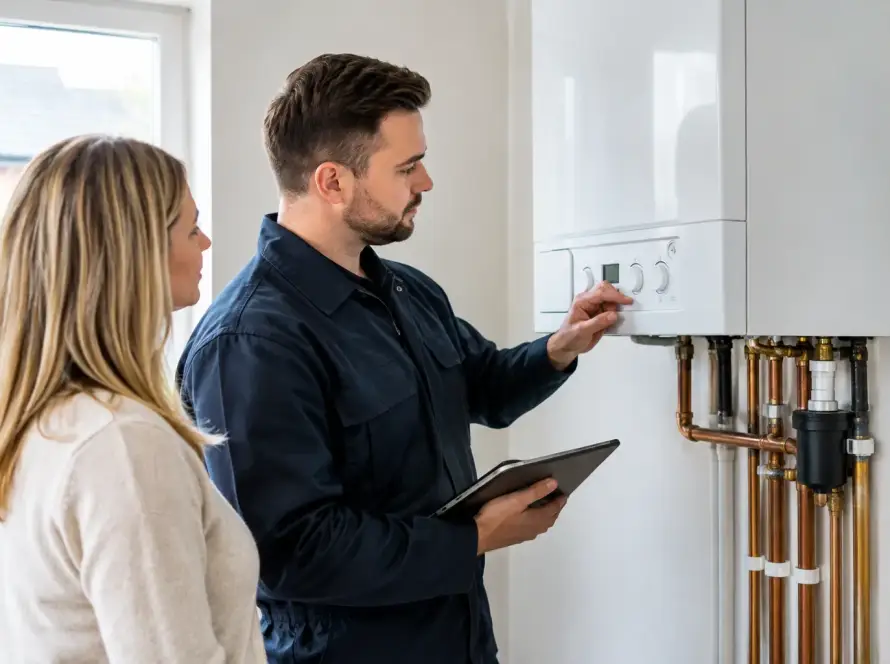


A boiler that is too small can leave the upstairs shower lukewarm when someone runs a tap downstairs. One that is oversized may cost more to buy without improving day-to-day comfort. The best boiler for 3 bedroom house depends less on bedroom numbers alone and more on your hot-water demand, bathrooms, radiators and the condition of the existing heating system.
For many homes in Bolton and Greater Manchester, a modern condensing combi boiler is the practical answer. But it is not automatically right for every property. A proper recommendation starts with how your household actually uses heating and hot water, not a guess based on floorplan alone.
What size boiler does a three-bedroom house need?
Most three-bedroom homes need a boiler with enough output to heat roughly 8 to 12 radiators comfortably. For the heating side of the calculation, a boiler in the 18kW to 24kW range is often sufficient, particularly in a reasonably insulated terraced or semi-detached property.
Hot water is usually what determines the final boiler size. Combi boilers heat water as you use it, so their domestic hot-water output needs to keep pace with showers, baths and taps. A 24kW to 30kW combi is commonly a good fit for a three-bedroom home with one bathroom. Where there is a larger shower, a high-flow rainfall shower, or more than one bathroom, a 30kW to 35kW model may be more suitable.
That does not mean every home needs the biggest boiler available. Boiler output should be matched to the property and its demand. An engineer will consider heat loss, radiator sizes, insulation, window quality, pipework and how many outlets might be used at once. This avoids paying for capacity you do not need while ensuring the system is not working flat out on a cold January morning.
Best boiler for a 3 bedroom house: combi or system?
The right boiler type matters as much as the kilowatt rating. The two options most homeowners compare are combi and system boilers.
A combi boiler for one bathroom
A combi boiler provides central heating and instant hot water from one compact unit. There is no separate hot-water cylinder, which makes it a popular choice where cupboard space is limited or a homeowner wants to remove an old cylinder tank.
For a three-bedroom house with one main bathroom and normal family use, a good-quality combi is often the most straightforward option. It is neat, efficient and delivers hot water on demand. It can also suit a house with a single shower, provided the incoming mains-water pressure and flow rate are healthy.
The trade-off is that a combi has a limit. If two showers are expected to run at the same time, or someone fills a bath while another person is showering, the water flow can be reduced. A larger combi improves flow, but it cannot create more water than the mains supply delivers.
A system boiler for greater hot-water demand
A system boiler works with a hot-water cylinder. It stores heated water ready for use, which makes it a strong choice for a three-bedroom house with two bathrooms, regular bath use or a busy household where simultaneous showers are likely.
An unvented cylinder can provide excellent shower performance where mains pressure is suitable. It does take up space, and the cylinder must be correctly designed, installed and maintained. However, for families who have outgrown the limitations of a combi, it can be a worthwhile upgrade rather than simply fitting a bigger boiler.
If your property already has a cylinder and the system is working well, changing to a combi is not always the best move. The decision should be based on your usage, available space and future plans for the home.
Boiler brands and features worth considering
There is no single boiler model that is best for every three-bedroom house. The best choice is a reliable boiler from an established manufacturer, fitted to a sound system by a Gas Safe registered engineer and supported by an appropriate warranty.
When comparing boilers, look beyond the headline price. Consider the hot-water flow rate, warranty length and conditions, availability of local parts, controls compatibility and whether the boiler is suitably sized for your system. A lower-priced installation can become poor value if it leaves you with weak shower performance, old contaminated pipework or controls that waste energy.
Modern boilers are condensing boilers, designed to recover more heat from the fuel they use. Their real-world efficiency still depends on the installation. Correctly sized radiators, clean system water, balanced pipework and well-set controls all affect how efficiently your home heats up.
Do not ignore the existing heating system
A new boiler can only perform as well as the system connected to it. If radiators have cold spots, some rooms never warm up properly, or the old boiler regularly loses pressure, these issues should be investigated before installation.
Older systems may need a chemical clean or powerflush, depending on their condition. A magnetic filter helps collect sludge and debris before it reaches the boiler. Radiator valves, pumps, wiring and the expansion vessel may also need attention. These are not unnecessary extras when they solve a known fault or protect a new appliance, but you should always be given a clear explanation of what is recommended and why.
It is also worth checking whether the radiator output is enough for the rooms. Loft conversions, extensions and rooms with poor insulation can need more heat than the original system was designed to provide. Fitting a powerful boiler will not compensate for undersized radiators.
Controls can make a noticeable difference
The best boiler installation includes controls that make heating easier to manage. A programmable thermostat lets you set heating around your routine, while smart controls such as Hive or Nest allow adjustments from your phone and can help prevent heating an empty house unnecessarily.
Thermostatic radiator valves give you room-by-room control. Bedrooms can be kept cooler than living areas, for example, rather than overheating the whole property. Weather compensation and load compensation controls can improve boiler efficiency further by allowing the boiler to run more gently when full output is not required.
Good controls are not about making a home complicated. They are about giving you clear, reliable control over comfort and running costs.
Questions to ask before choosing a boiler
Before accepting a boiler quote, make sure the recommendation answers the practical questions. How many bathrooms and showers are there? Does anyone regularly use hot water at the same time? What is the incoming mains-water flow rate? How many radiators are fitted, and are any rooms consistently cold? Is a cylinder already in place? Are you planning an extension, loft conversion or additional bathroom soon?
Also ask what work is included. A clear quotation should state the proposed boiler, warranty, controls, filter, condensate arrangement, any system cleaning, flue work and disposal of the old boiler. It should explain whether repairs to pipework, radiators or electrical controls are needed, rather than presenting surprises once work starts.
When it is time to replace rather than repair
A repair is often sensible where a boiler is relatively young and the fault is isolated. Replacement becomes more attractive when breakdowns are recurring, spare parts are difficult to obtain, repair costs are mounting, or the boiler is no longer suited to the household’s needs.
If you are replacing a boiler after an emergency failure, it can be tempting to choose the first available model. Taking a little time to assess boiler type, hot-water demand and system condition can prevent years of compromise. For homeowners who want straightforward advice and a fixed-price quotation, GASCON can assess the property and explain the options in plain English.
A three-bedroom house deserves a boiler that keeps every room comfortable and delivers the hot water your household needs. Choose the system around the way you live now, with enough flexibility for the changes you may make next.