

A boiler that is too small can leave you with lukewarm showers and rooms that never quite feel warm. One that is unnecessarily large can cost more to buy and may not run as efficiently as it should. Knowing how to choose boiler size means looking beyond the number of bedrooms and considering how your household actually uses heating and hot water.
For homeowners and landlords in Bolton and the surrounding areas, the right answer depends on the property, the existing system and everyday demand. A proper survey gives the most reliable result, but understanding the basics will help you ask the right questions when comparing replacement options.
How to choose boiler size: start with kW output
Boiler size is measured in kilowatts, written as kW. This describes the boiler’s maximum output, not its physical dimensions. Higher kW figures generally mean a boiler can produce more heat or hot water, but bigger is not automatically better.
For central heating, the boiler needs enough output to replace the heat your home loses on a cold day. For combi boilers, hot water demand often becomes the deciding factor. A combi has to heat water as it passes through the appliance, so a household with one bathroom and modest hot water use may suit a different output to a similar-sized home with two showers used back-to-back each morning.
It is also worth separating boiler output from boiler efficiency. A modern, correctly installed condensing boiler can be highly efficient, but it still needs to be correctly sized, commissioned and controlled to perform well.
Your boiler type changes the calculation
The type of boiler is just as relevant as its output.
Combi boilers
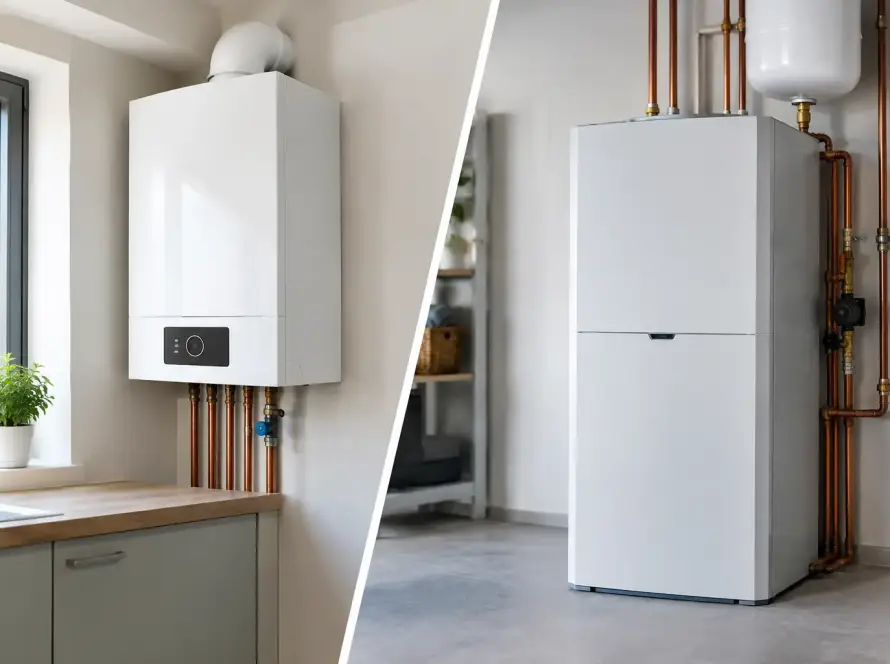
A combi boiler provides heating and mains-pressure hot water without a separate hot water cylinder. It is often a practical choice for smaller homes with one bathroom, particularly where space is limited. Its hot water flow rate is usually the key consideration.
As a broad guide, a 24-28kW combi can often suit a flat, terrace or smaller three-bedroom home with one bathroom. A 30-35kW model may be more appropriate where there is a larger home, a higher-output shower or more frequent hot water use. This is only a starting point. Poor incoming mains water pressure or flow can restrict shower performance regardless of the boiler’s kW rating.
Combi boilers are less suitable for every situation. If two or more people regularly need showers at the same time, or the property has several bathrooms, a stored hot water solution can provide a better experience.
System boilers
A system boiler works with a separate hot water cylinder. The cylinder stores heated water, allowing several outlets to be used around the home, subject to the cylinder capacity and system design. This can be a strong option for larger households and homes with multiple bathrooms.
The boiler output is then mainly selected around the heating load and how quickly the cylinder needs to recover after use. A bigger cylinder is not always the solution either. It needs suitable space, correct controls and, for unvented cylinders, installation by a properly qualified engineer.
Regular boilers
Regular, or heat-only, boilers are normally found on older systems with a hot water cylinder and tanks in the loft. They can still be a sensible choice where the property has an existing traditional system or where water pressure is not suitable for a combi conversion.
Replacing like for like can sometimes keep disruption down. However, if you are renovating, adding radiators or changing bathrooms, it is the right time to review whether the whole system still meets your needs.
Count radiators, but do not stop there
The number and size of radiators affect the heating requirement, but simply adding up radiator outputs does not tell the full story. Each room loses heat at a different rate. A south-facing, well-insulated bedroom needs less heat than a large north-facing lounge with older windows and an external wall.
An engineer should consider the room dimensions, wall construction, insulation, glazing, ceilings, draughts and the temperature you want to achieve. This is known as a heat-loss calculation. It is particularly valuable for extensions, converted lofts, older properties and homes where certain rooms have always felt cold.
Radiators also need to be matched to the temperatures at which a modern boiler runs best. Lower flow temperatures improve condensing boiler efficiency, but radiators may need to be larger to deliver enough heat at those lower temperatures. This is one reason a like-for-like boiler swap is not always the whole answer.
Consider hot water habits honestly
Two households can live in identical three-bedroom houses and need different boiler setups. One may have a single occupant who showers at the gym and rarely runs a bath. The other may have a family getting ready at the same time, with a main shower, en-suite and kitchen tap all in regular use.
Think about the busiest part of a normal day. Do you need one good shower at a time, or are two bathrooms likely to be used together? Do you fill a large bath often? Is there an en-suite extension planned? These details help determine whether a larger combi, a system boiler with cylinder or a different layout will offer the best balance.
For a combi boiler, the stated litres-per-minute hot water flow rate can be more useful than focusing on kW alone. Ask what flow you can realistically expect at your property, taking account of the incoming water supply. An oversized combi cannot create pressure that is not available from the mains.
Do not rely on bedroom-count rules alone
Online boiler size charts can be useful for an initial idea, but they cannot see your insulation levels, radiator sizes, pipework condition or hot water demand. A three-bedroom semi-detached house could need a very different solution from a three-bedroom detached period property.
Be cautious of rules such as “one boiler size per bedroom”. They may overlook important factors including:
- the number of bathrooms and how they are used
- the size, type and condition of radiators
- insulation in the loft, walls and floors
- extensions, conservatories and converted spaces
- mains water flow and pressure
- planned changes, such as an en-suite or loft conversion
A boiler should have enough capacity to meet peak demand, but excessive oversizing is not a shortcut to better comfort. Modern boilers can modulate their output down when demand is low, yet selecting a model that is sensible for the property still supports efficient, steady running.
Look at the whole heating system
A new boiler installed onto a neglected system may not deliver the improvement you expect. Sludge, poor circulation, undersized pipework, failing radiator valves and incorrect controls can all affect performance.
Before choosing a boiler, ask whether the installation should include a system clean, magnetic filter, thermostat upgrade, smart controls or replacement radiator valves. Zoned heating and smart controls such as Hive or Nest can help you heat the rooms you use, at the times you need them. They do not replace correct boiler sizing, but they can make a well-designed system easier to control and cheaper to run.
If you are extending the home or replacing several radiators, have the heating design reviewed before the boiler is ordered. This avoids fitting a new appliance around assumptions that no longer apply.
What a professional boiler survey should cover
A good survey should feel like a conversation, not a quick guess based on the boiler cupboard. The engineer should ask about your heating and hot water routines, inspect the current system and check practical installation details such as flue position, condensate drainage, pipework and electrical connections.
They should also explain the trade-offs in plain English. For example, a combi may free up airing-cupboard space, while a system boiler and unvented cylinder may better suit a busy household with several bathrooms. You should receive a clear quotation outlining the proposed boiler, controls and any recommended system work.
For work on gas appliances, always use a Gas Safe registered engineer. At GASCON, we assess the property and how you use it, rather than simply recommending the highest kW figure available. It is the practical details that determine whether a boiler will feel right every day.
Plan for the home you will have, not only the home you have now
If a new bathroom, extension or growing family is likely within the next few years, mention it during the survey. Choosing a system that can accommodate realistic future demand may prevent an expensive compromise later. Equally, do not pay for capacity you are unlikely ever to use.
The best boiler size is the one that keeps your home comfortably warm, delivers the hot water your household needs and works efficiently with the system around it. A careful survey before installation is a small part of the project, but it is where a dependable heating system begins.